Mostly about building products, healthcare tech, and lessons learned along the way.
Loading articles
The Open-Weight LLM Landscape in 2026: What Engineers Actually Need to Know | Clint Johnson
The Open-Weight LLM Landscape in 2026: What Engineers Actually Need to Know
The models you can run yourself are getting serious
There's a version of the enterprise AI story that goes: you pick a capable frontier model, you call the API, and the only real question is prompt engineering. That story has never been true in healthcare, and it's becoming less true everywhere.
If your application touches protected health information, you can't just POST it to OpenAI. PHI leaving your environment is a HIPAA problem regardless of how the vendor's data processing addendum is worded. You either build the legal scaffolding to make it work (BAAs, audit logs, data handling agreements, contractual indemnification), or you run the model on infrastructure you control. For most healthcare teams operating at startup or mid-market scale, "run it yourself" is the simpler path.
Which means the quality of open-weight models is not an academic question for us. It's a deployment question. In 2026, the open-weight ecosystem has gotten genuinely good, fast enough that a lot of engineers haven't updated their mental model of what's available.
This article is that update: what's changed in open-weight LLM architecture, why it matters for on-premise deployments, and how to make a defensible model selection decision today.
Why Open-Weight Wasn't Good Enough — and Why It Is Now
Two years ago, the gap between frontier models and the best available open-weight alternatives was meaningful. Not insurmountable for specific tasks with fine-tuning, but real. For clinical summarization, the difference between GPT-4 and an open-weight alternative was noticeable enough that you felt it in user feedback within weeks.
That gap has compressed substantially. The most capable open-weight models today, models like Qwen2.5, Llama 3.3, Mistral Large, and DeepSeek-V3, are competitive with GPT-4-class performance on most practical NLP benchmarks. More importantly, they're competitive on the tasks that matter for healthcare: instruction following, long-document understanding, structured extraction, and generation quality on clinical text.
Three architectural trends drove the compression, and I've been watching all three play out in production over the last year.
Architecture Trend 1: MoE Is Now the Default for Serious Models
I help teams ship AI in production — audits, consulting, custom agents, and eval systems. Start with an AI Audit (from $5k) for an honest read on what to build.
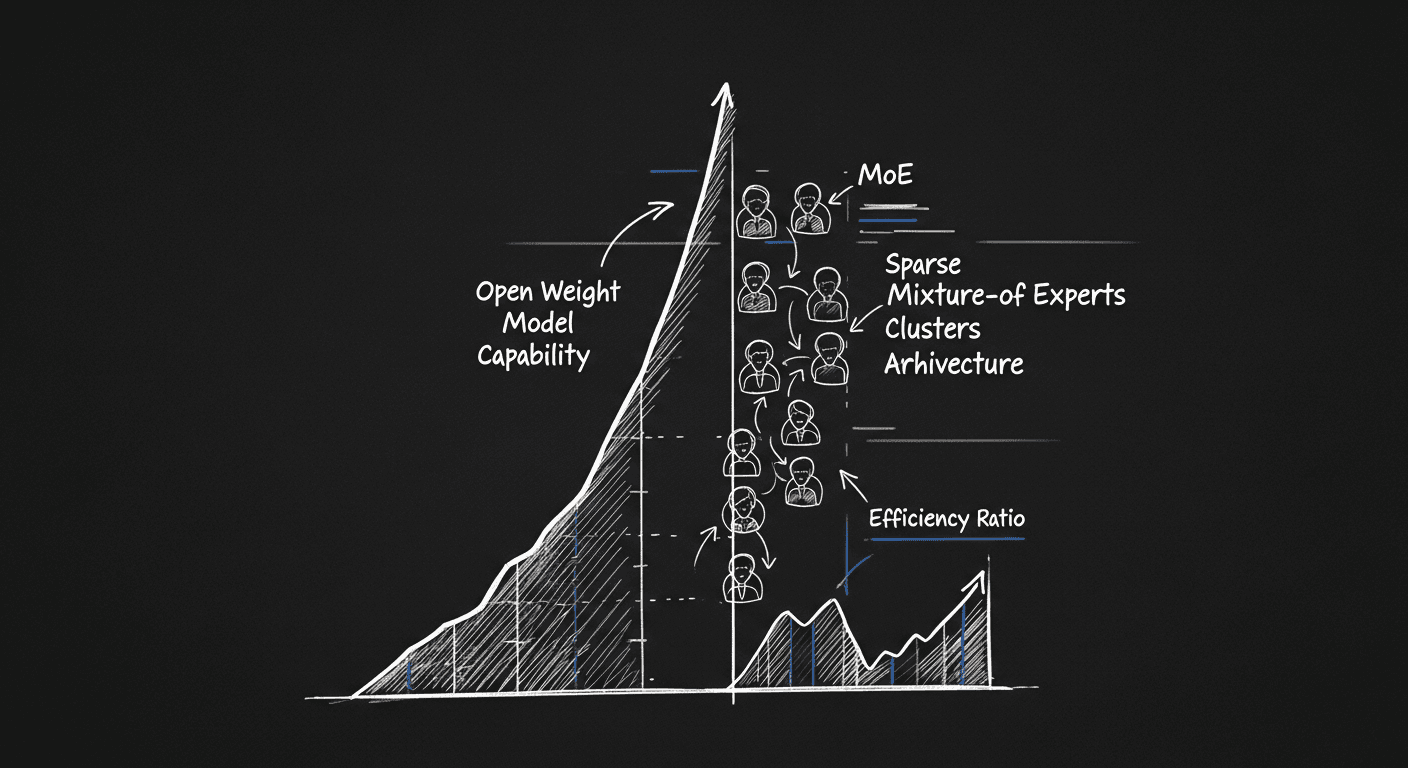
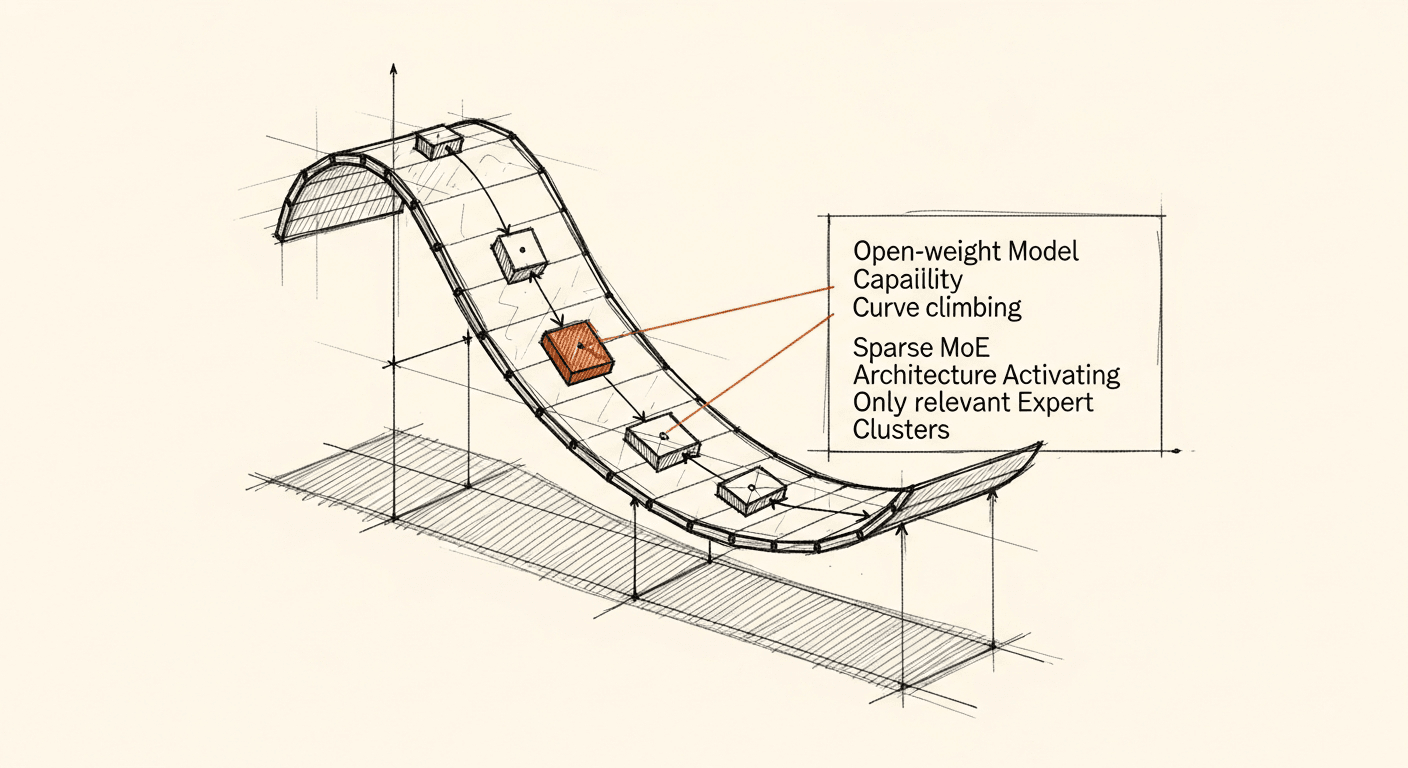
Mixture of Experts has moved from a research novelty to the dominant architecture for high-parameter-count open-weight models. The practical implication is significant: MoE lets you run a 400B-parameter model on hardware that would never support a 400B dense model, because at inference time you're only activating a fraction of the parameters for any given token.
DeepSeek-V3 is a useful reference point. It has 671B total parameters. At inference, it activates roughly 37B. The model achieves frontier-quality outputs while running at the compute cost of a model an order of magnitude smaller.
For on-premise deployment, this changes the hardware math entirely. A model with the effective capacity of a 400B+ parameter system no longer requires a cluster. A few high-end nodes with NVLink, or a well-configured multi-GPU setup with good batching, gets you there. An enterprise ML team with a real but not extravagant GPU budget can deploy this.
The tradeoff: MoE models are more complex to serve. Expert routing adds overhead, memory bandwidth requirements are higher than parameter count alone suggests, and frameworks like vLLM have had to evolve to handle them efficiently. The tooling has caught up considerably, but this is still an engineering surface area that dense models don't require.
Architecture Trend 2: Attention Efficiency Is Getting Serious Attention
The shift from Multi-Head Attention to Grouped Query Attention (GQA) was the dominant KV-cache optimization story for the last two years. GQA reduces the size of the key-value cache by sharing K and V heads across groups of Q heads, reducing memory requirements for long-context inference without meaningfully degrading quality.
What's happening now is more interesting. Multi-Head Latent Attention (MLA), pioneered by DeepSeek, compresses the KV cache further by projecting keys and values into a lower-dimensional latent space. The result is a KV cache significantly smaller than GQA at equivalent sequence lengths, which matters a lot when you're running long clinical documents through a model.
The parallel track is hybrid linear attention: architectures that mix standard softmax attention with linear attention mechanisms (SSMs, state space models, RWKV-style layers) to reduce the quadratic scaling of attention as context grows. Models like Falcon-Mamba and others in the SSM family are exploring this space. For inference on very long contexts, this changes the performance profile substantially.
Why does this matter operationally? Context window costs are not symmetric. A model with a 128K token context window that uses naive attention is prohibitively expensive to fill on most inference hardware. The same window with MLA or hybrid attention becomes usable. That's the difference between an architecture spec and a deployable product.
Architecture Trend 3: Context Windows Are Getting Useful Long
The context window arms race has been running for two years, but the architectural improvements above are what make long context practically viable rather than theoretically available.
For clinical applications specifically, this matters concretely. A full patient encounter, the history, the vitals trend, the nursing notes, the attending's assessment, can exceed 20,000 tokens without being unusual. Inpatient stays with rich documentation can run into six figures. The traditional answer has been chunking and RAG, which works but introduces retrieval quality dependencies, latency costs, and the persistent failure mode of relevant context getting dropped because it didn't rank well at retrieval time.
A model with a 128K effective context window that can process all of it in one pass removes an entire class of engineering problems. It's not a reason to abandon RAG: RAG still makes sense for retrieval at scale. But it changes the baseline. The simple cases get simple again.
The practical caveat: effective context is not the same as advertised context. A lot of models that nominally support 128K tokens degrade significantly in the middle of long contexts. The "lost in the middle" problem has been documented extensively. When evaluating context window claims, test specifically with information placed in the middle third of the context. If retrieval accuracy from that position degrades, the window isn't usable at its advertised length.
What This Means for Healthcare AI Engineers
The convergence of MoE efficiency, attention improvements, and genuine long-context capability changes the calculus for on-premise deployment in a few specific ways.
PHI stays on your hardware. This is the non-negotiable in healthcare. With MoE models now deployable on serious but not exotic GPU configurations, the hardware barrier for running frontier-quality models on-premise has dropped to a budget conversation, not a feasibility conversation. If you're running HIPAA-covered workloads, this path is more accessible than it was eighteen months ago.
Long clinical notes fit. Improved context handling and architectural efficiency together mean that workflows requiring full-document understanding, comprehensive discharge summary generation, multi-visit longitudinal summarization, chart review for complex cases, are now achievable without the engineering overhead of chunking pipelines. The failure modes are simpler and more auditable.
Fine-tuning is worth it now. A model you can run on your own hardware is a model you can fine-tune on your own hardware. The DPO and QLoRA tooling for open-weight models has matured substantially (I wrote about this separately). A capable base model plus domain-specific alignment on your clinical data is a genuinely competitive stack. A cloud API can't replicate it, because you own both the model weights and the fine-tuning data.
How to Pick a Model Today
Given all of the above, here's how I'd approach model selection for a new on-premise healthcare AI project in 2026.
Start with your hardware envelope, not the benchmark leaderboard. What GPUs do you have or can you realistically provision? MoE models give you more capability per hardware dollar, but they require careful memory planning. A dense model that fits cleanly on your infrastructure will serve you better than a theoretically superior MoE model you're constantly fighting to keep in memory. Benchmark a few candidates on your actual hardware under realistic batch sizes before you commit.
Evaluate on your data, not on public benchmarks. MMLU scores don't predict clinical summarization quality. Run your top candidates against a held-out set of real clinical cases, ideally reviewed by clinicians who can rank outputs. Preference data from this evaluation is directly useful for DPO fine-tuning afterward, so the effort compounds.
Weight context faithfulness over context window size. Test with realistic document lengths from your actual use case. Place critical information at different positions in the context. If a model reliably drops information from the middle of a 40K token document, the 128K advertised window is irrelevant to your use case. The model that performs best on your actual document structure wins, regardless of the spec sheet.
Plan for iteration. The open-weight landscape is moving fast enough that the model you deploy today will have meaningfully stronger successors in twelve months. Build your serving and fine-tuning infrastructure to make model updates low-friction. The teams that win here aren't necessarily running the best model at any given moment. They're the ones who can adopt improvements without a three-month re-architecture every time.
Mistral, Qwen, and DeepSeek are the families worth tracking closely. All three have demonstrated consistent improvement across releases, strong open licensing for commercial use, and active community support. Llama remains a strong baseline with excellent ecosystem tooling. For healthcare specifically, I'd evaluate Qwen2.5 and DeepSeek-V3 seriously: both have strong multilingual and instruction-following performance that generalizes well to clinical text.
The Ecosystem Is Mature Enough Now
A year ago, recommending open-weight models for production healthcare AI required a lot of caveats. The capability gap was real, the tooling was rough in places, and the organizational risk of "we built our own LLM deployment" was hard to justify when the product wasn't quite there.
In 2026, most of those caveats have collapsed. The capability gap against frontier proprietary models is narrow on the tasks that matter. The serving infrastructure, vLLM, llama.cpp, Ollama for lighter workloads, is genuinely production-ready. The fine-tuning tooling is accessible to a team of reasonable size without specialized ML infra expertise.
The PHI constraint hasn't changed. It won't. But the quality of what you can run on-premise has changed enough that the constraint no longer forces a painful compromise. You can build a healthcare AI product on open-weight models that competes with what you'd build on top of a cloud API, on hardware you control, with data that never leaves your environment.
For most healthcare AI teams, that's not a consolation prize. It's the right architecture.