Mostly about building products, healthcare tech, and lessons learned along the way.
Loading articles
Trading Speed for Quality: A Practical Guide to Inference-Time Scaling | Clint Johnson
Trading Speed for Quality: A Practical Guide to Inference-Time Scaling
Spending more compute at inference: when it works and when it does not
Six months ago I had to make a call that felt like it should be easy but wasn't. We were routing patient triage requests through an AI system — flagging urgency, surfacing relevant history, suggesting next steps. The product team wanted sub-second latency. The clinical team wanted it to be right. I had to pick one.
I picked speed. For triage routing, speed is the point: a three-second lag in a high-volume intake flow causes real downstream friction, and the model was doing pattern-matching at a level where extra compute wouldn't meaningfully change outcomes. Three months later, the same underlying tension surfaced in a different context: differential diagnosis support. Same company, same stack, totally different answer. There, accuracy was the point. Getting the right differential with lower latency was a bad trade.
What I didn't have at the time was a framework for making this decision deliberately. I was pattern-matching on instinct. Categorizing the inference-time scaling strategies gave me the vocabulary I was missing — and reframed how I think about model selection entirely.
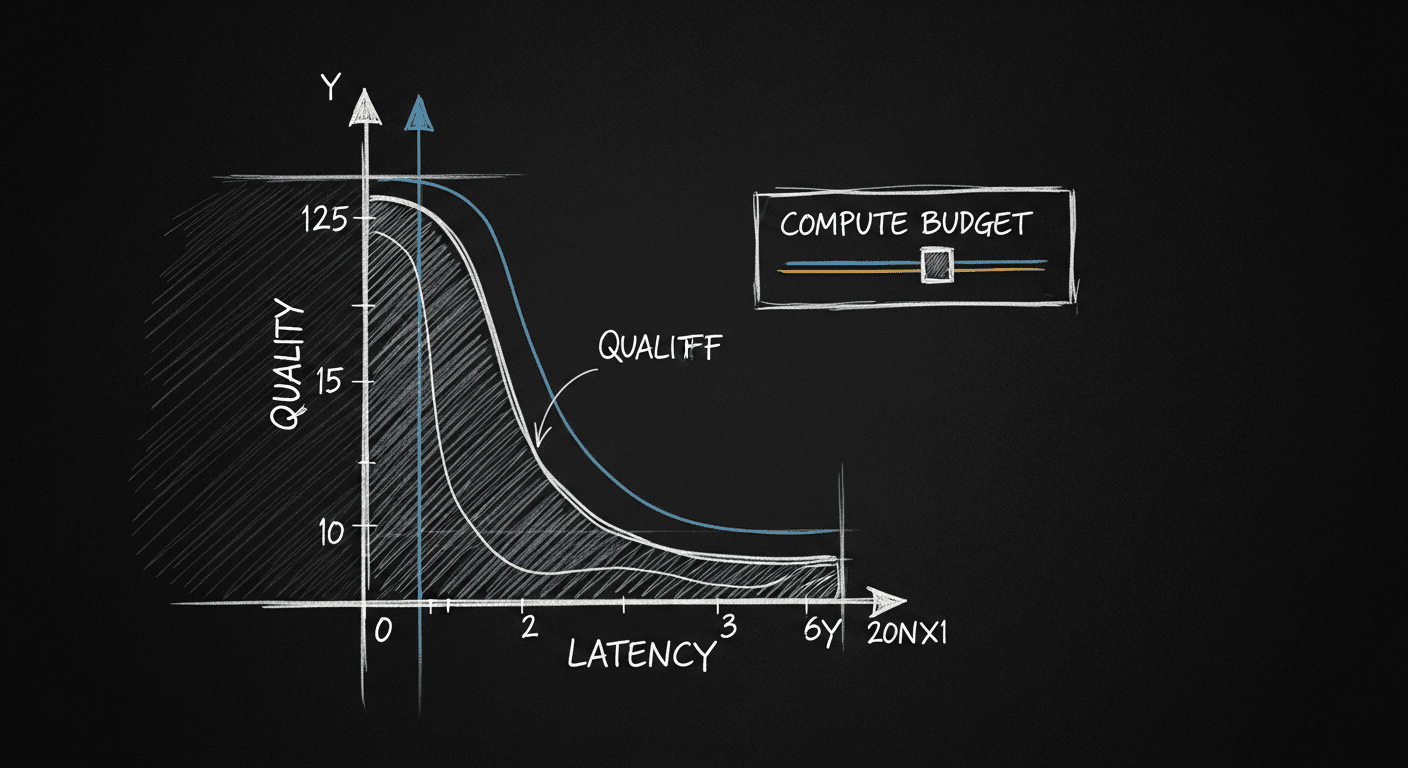
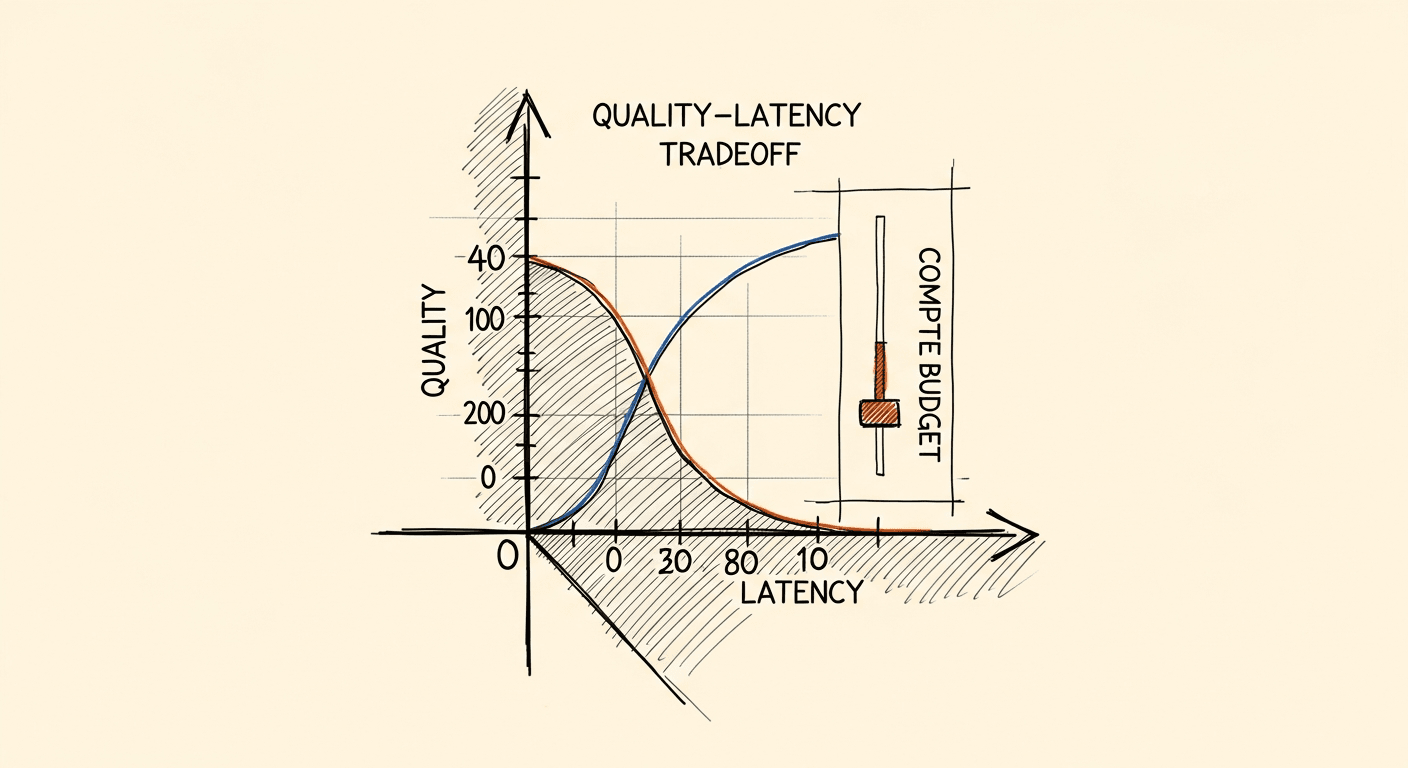
The insight: the latency-quality tradeoff is not fixed at training time. It's tunable at inference time, for every request, if you know what you're doing.
What Inference-Time Scaling Actually Is
Most practitioners treat model selection as the primary quality lever. You want better outputs, you reach for a bigger model. This intuition isn't wrong, but it's incomplete.
A model's capability has two dimensions: what it knows (training) and how hard it thinks (inference). You can affect the second dimension at runtime without touching the first. That's inference-time scaling — spending more compute at the moment of inference to get better outputs from the same underlying weights.
This matters because it decouples quality from model size. A smaller model given the right inference strategy can outperform a larger model on a single forward pass. Four strategies cover most practical use cases:
Best-of-N sampling — generate N candidate outputs, return the best one according to some selection criterion.
Beam search / tree search — explore multiple reasoning paths in parallel, pruning less promising branches as you go.
Iterative refinement — generate an initial output, then revise it one or more times using feedback from a verifier, tool, or critic.
I help teams ship AI in production — audits, consulting, custom agents, and eval systems. Start with an AI Audit (from $5k) for an honest read on what to build.
Confidence-based adaptive compute — scale inference compute dynamically based on how uncertain the model appears to be, spending more on hard examples and less on easy ones.
Each of these has a different latency cost, a different quality ceiling, and a different set of conditions under which it helps.
The Four Strategies, Practically
Best-of-N Sampling
The bluntest instrument in the toolkit, and often the most effective one. You call the same model N times and pick the best output. "Best" can be defined by token probability (the model's own confidence signal), by a reward model score, or by a domain-specific verifier.
The quality gains are not marginal. On hard reasoning tasks, a model that gets 40% of problems right on a single attempt can clear 80%+ when you sample 16 times and select the highest-scoring result. The underlying capability was never the bottleneck — the model just needed more attempts to express it.
The cost is linear. Three attempts costs three times as much. At scale that matters. For high-stakes outputs where errors are expensive, the cost arithmetic often still favors Best-of-N over trying to brute-force quality from a bigger base model.
Clinical context where this earns its cost: structured data extraction from clinical notes. A med rec extraction that feeds a downstream decision system needs to be right. Generating five candidates and running a lightweight verifier catches a class of errors that prompt engineering alone doesn't reliably prevent.
Beam Search and Tree-of-Thought
Where Best-of-N is parallel and independent, beam search is serial and selective. You maintain K candidate reasoning paths simultaneously, evaluate each at each step, and prune the least promising ones before continuing. This is the mechanism behind the performance of o-series reasoning models: not magic, but a structured search over reasoning trajectories.
Tree-of-Thought extends this further, allowing branching at arbitrary reasoning steps rather than just token-by-token. The result is a model that can explore "what if I approached this differently" mid-reasoning rather than only across full attempts.
The practical implication: beam search is what you want when the problem is reasoning-hard — multi-step logic, mathematical derivation, code with complex dependencies. It won't help you if the issue is that the model doesn't know the fact you need, because structured search doesn't improve recall.
Clinical context where this applies: differential diagnosis support. A differential is reasoning-heavy. The right answer depends on combining multiple clinical signals through a chain of conditional logic. More thinking space — explicitly or through a reasoning model — produces materially better outputs. One-shot Haiku doesn't.
Iterative Refinement
The model produces an initial answer, receives feedback, revises. The feedback can come from a code interpreter that ran the output, a second model acting as a critic, a structured rubric, or the original model prompted to critique its own work.
This is the backbone of every agentic loop I've built. It's also where I see the most failure. The failure mode isn't in the revision step — it's in the feedback signal. Revision loops with vague feedback ("is this good?") cycle without improving. Revision loops with precise, grounded feedback ("the SQL query returned this error: ...") converge quickly toward correct outputs.
My rule: iterative refinement earns its cost only when you have a feedback signal that is both specific and verifiable. Tool output qualifies. Another model's general quality assessment usually doesn't, unless that model is operating against a calibrated rubric on a well-understood failure mode.
Confidence-Based Adaptive Compute
The most elegant strategy and the hardest to implement well. The idea is to spend inference compute proportional to example difficulty — quick and cheap for easy inputs, slow and expensive for hard ones. Token probability distributions are the most accessible signal: if the model's output probabilities are flat across the top candidates, it's uncertain, and that uncertainty is evidence you should spend more compute on this input.
In production this requires routing infrastructure. You need to detect the uncertainty signal, branch to a higher-compute path, and merge the result back without introducing latency in the uncertain-fast case. That's nontrivial engineering. The payoff is meaningful for high-volume systems where most inputs are easy and a small fraction are genuinely hard — you stop paying for Best-of-N on everything just to protect against the difficult tail.
The Decision Framework
Here is how I make this call. The columns are the four strategies; the rows are the questions I ask first.
Scenario
One-shot (fast model)
Best-of-N
Beam / Tree search
Iterative refinement
Latency budget under 1 second
✅
Pattern-matching / classification task
✅
Factual recall, retrieval-grounded answer
✅
High volume, mostly simple inputs
✅ (with adaptive routing)
High-stakes output, errors are expensive
✅
Verifiable correct answer exists
✅
Batch job, latency not a constraint
✅
Reasoning-heavy, multi-step logic
✅
Differential diagnosis, code with complex deps
✅
Tool-grounded feedback available
✅
Agentic loop with sharp exit condition
✅
Output can be validated by a downstream check
✅
The through-line: use more compute when errors are expensive and when you have a way to verify that extra compute produced a better output. Spend less when you have a reliable quality floor and a real latency constraint.
The Model Selection Reframe
The question I used to ask first: "Which model should I use?" The question I ask first now: "What inference strategy does this task support?"
That reframe changes which model tier you end up on. A task that supports Best-of-N verification can often be served by a cheaper base model running multiple times — the total cost is lower than a single call to a frontier model, and the quality is often equivalent or better. A task that needs beam search has reasoning model written all over it, but that doesn't mean you need the largest reasoning model — it means you need a model trained to use extended thinking, at whatever size clears the quality bar.
For the clinical AI work I do, the practical breakdown looks like:
Triage routing, encounter classification, intent detection — one-shot, fast model, real-time latency. The model is doing pattern recognition on well-understood signal. Speed matters. Extended compute doesn't help.
Structured data extraction, prior auth summarization, medication reconciliation — Best-of-N with a verifier. Errors have downstream consequences. Latency budget allows a few seconds. Three to five candidates with a scoring pass catches the failure mode that matters.
Differential support, clinical decision support, complex protocol matching — reasoning model with extended thinking or beam-search-based exploration. The problem is reasoning-hard. More thinking space produces better outputs. Cost is justified by what's at stake.
Agentic clinical workflows, code generation for health data pipelines — iterative refinement with tool-grounded feedback. The loop runs until the output passes the test, exits on failure, and doesn't cycle indefinitely on a fuzzy signal.
What Gets Missed
The most common mistake I see is teams defaulting to larger frontier models when inference strategy is the actual lever. The symptom: they're spending significantly on API costs, the outputs are acceptable but not great, and the team's instinct is to upgrade the model tier. In most of these cases, the task has verifiable outputs and a flexible latency budget. Best-of-N with the model they already have would produce better results at lower cost per correct answer.
The second mistake is reaching for reasoning models on tasks that aren't reasoning-hard. A reasoning model asked to classify an intake form wastes expensive extended thinking on a problem that doesn't benefit from it. The quality ceiling for that task is set by how well the model knows the domain, not by how long it thinks. Matching inference strategy to problem type is the whole game.
The tradeoff between speed and quality is not a fixed property of your model. It's a parameter you set every time you build a new feature. Build the habit of asking which parameter value fits the task before you ask which model fits the task. That question-order change will save you money and produce better products.
The triage call I made six months ago was right for the wrong reasons. I chose speed because it felt right, not because I had mapped the task to an inference strategy. Having the framework now doesn't change the outcome for that feature — but the next ten decisions get made faster, cheaper, and with less second-guessing. That's what a practical framework is for.