Mostly about building products, healthcare tech, and lessons learned along the way.
Loading articles
Time vs. Timing: The Career Framework I Wish I Had Earlier | Clint Johnson
Time vs. Timing: The Career Framework I Wish I Had Earlier
Some bets compound. Some expire. AI is both.
In 2013, I made a bet on healthcare AI. Nobody was talking about it. EHR interoperability was a mess of HL7v2 messages and fax machines. The obvious career move was enterprise SaaS or consumer mobile. I went the other direction: joined a small team trying to build clinical decision support on top of data that barely existed in structured form.
That bet worked. Not because I outworked anyone. Because the window was opening and I was already in the room.
Two years earlier, I had made a different kind of bet: I committed to going deep on full-stack engineering. Not because the timing was special. Because compound interest on foundational skills is always accruing, and I wanted to be collecting it. That bet also paid off, but for entirely different reasons.
I've been thinking about this distinction for a while. The framing that finally gave me precise language for it, time versus timing, captured something I had been feeling but couldn't articulate cleanly.
Confusing the two is one of the most common strategy errors I see in engineering careers.
The Distinction
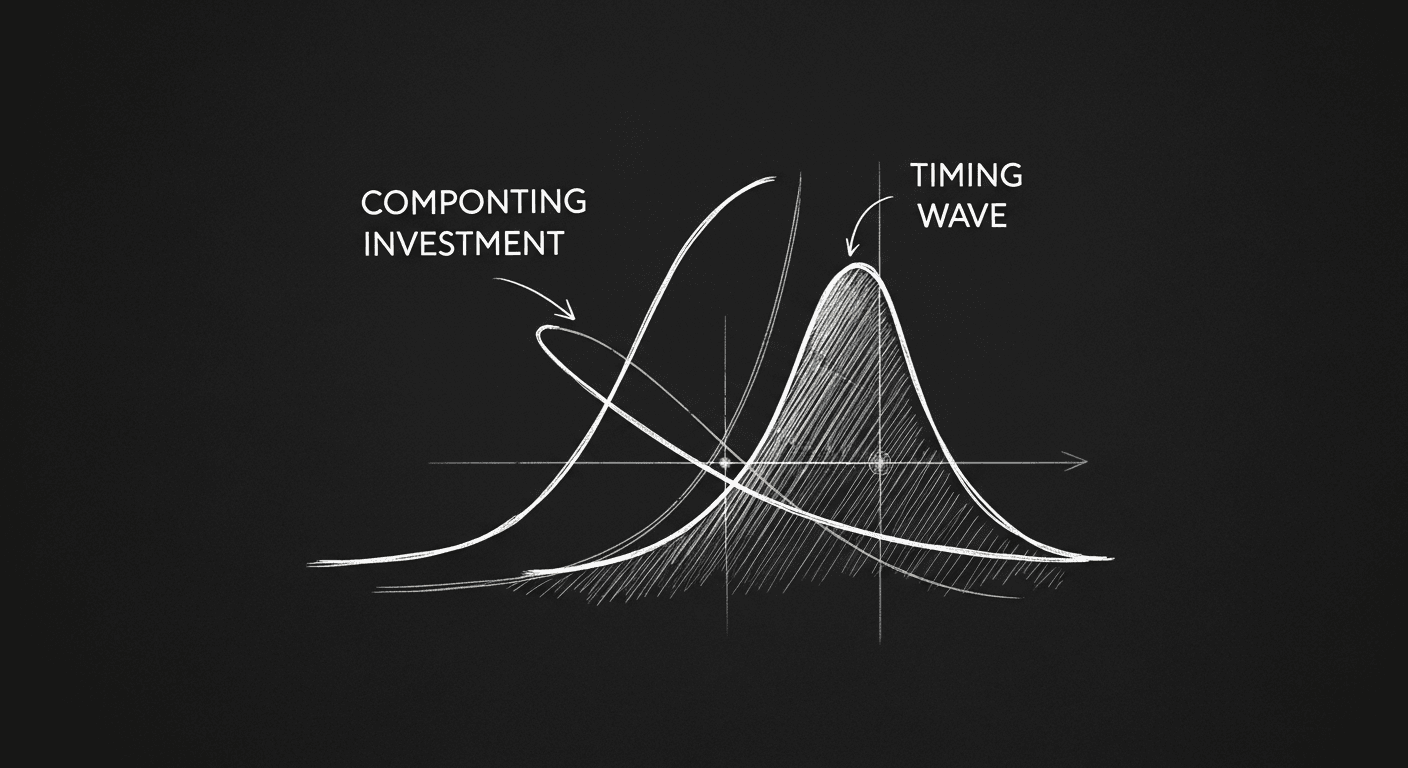
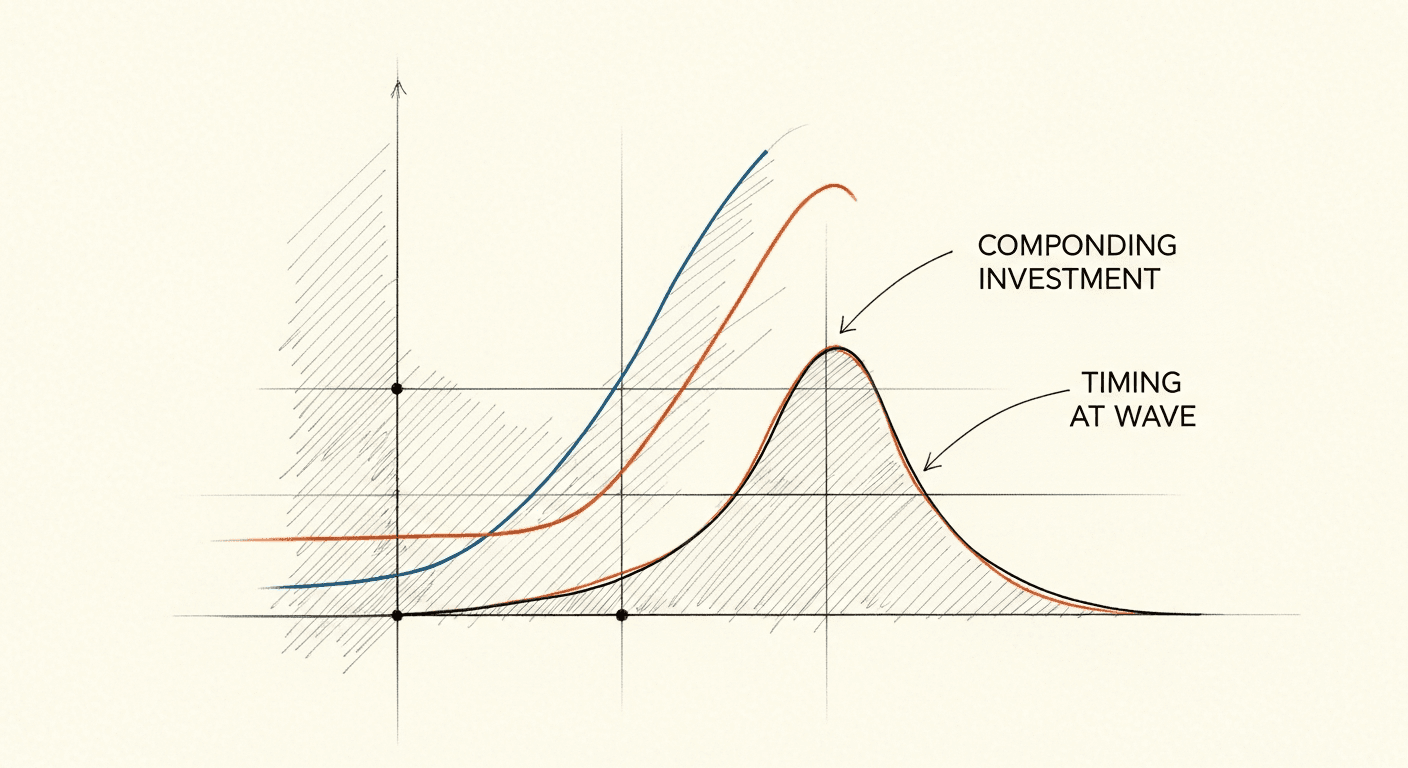
Time is about compounding. Invest consistently in something, let the returns accumulate, and the gap between you and someone who didn't invest becomes exponential over years. Deep systems knowledge. Domain expertise. Writing skills. The ability to communicate technical tradeoffs to non-technical people. These things compound.
Timing is about windows. Some opportunities exist only in specific moments: when a technology is emerging but not yet crowded, when a market gap is visible but the obvious players haven't moved, when a company is at the inflection point where the work matters. These windows open and close. Being good at the right time matters. Being great after the window closes does not.
Both are real. Both matter. The failure mode isn't preferring one over the other. It's applying the wrong one to the wrong kind of bet.
When to Optimize for Time
The clearest signal that you're looking at a time bet is when the returns are nearly invariant to when you start, only to how long you've been doing it.
Learning how distributed systems fail under load: start now, start in two years, the compounding value is similar. Depth and duration matter. Catching a wave does not.
I help teams ship AI in production — audits, consulting, custom agents, and eval systems. Start with an AI Audit (from $5k) for an honest read on what to build.
Building genuine domain expertise (healthcare, fintech, logistics, whatever your vertical is)
Learning to write well and explain complexity clearly
Understanding how businesses generate and lose money
Developing the judgment to know which problems are worth solving
These aren't exciting claims. Compounding rarely is. They're worth more than almost anything timing-dependent, because they keep paying out regardless of what the market is doing.
The mistake I see most often: engineers treat every skill as a timing bet. They chase the new framework, the new model architecture, the new tool trending on HackerNews. There's nothing wrong with staying current. The problem is treating currency as compounding, when it's maintenance.
Currency, knowing the current tool, depreciates. Depth, understanding why the tool works and what problem it solves, compounds.
When to Optimize for Timing
Timing bets have a different shape. The value is high now and uncertain later. The market for a skill, a role, or a company type is underpriced relative to where it's heading, and there's a specific window to get in before that changes.
My healthcare AI bet in 2013 was a timing bet. The value of that specific entry, being in the room before the room filled up, was real and time-limited. If I'd made the same career move in 2019, when digital health was obviously hot and every VC had a health AI thesis, the timing premium would have been gone. I might still have learned valuable things. But the windows-open, wave-is-forming advantage was closed.
Timing bets require three things to pay off:
1. The window actually exists. This is harder to verify than it sounds. Every generation of engineers thinks it's catching a wave. Most are just getting wet.
2. You can execute during the window. Being in the right place at the right time with the wrong skills is still a loss. Timing bets are most valuable when layered on top of compounding investments.
3. You can recognize when the window closes. Staying in a timing-dependent role or skill set after the premium has compressed is inertia. The company that was early-stage exciting becomes the company with the calcified tech stack and the overstaffed team.
I've made timing bets that didn't work out. Mobile app development before the frameworks matured: I got in early, but the friction was real and the standards shifted faster than I could compound on what I'd built. Early doesn't always mean advantaged.
The AI Wave Is Both. And That's Rare.
The current AI moment is genuinely unusual through this lens: it's a timing bet and a time bet simultaneously. These don't usually coincide.
The timing bet: there's a specific 18-to-24-month window, call it 2024 to late 2026, where technical fluency with AI systems is meaningfully differentiated rather than table stakes. Engineers who can build real evaluation frameworks, design agent workflows that work in production, and reason clearly about where models fail occupy a category of their own right now. That category will get crowded. The window will close.
The time bet: understanding how machine learning systems work, not just how to call an API, but the underlying failure modes, data quality dependencies, and evaluation discipline required to ship responsibly, is compounding knowledge. It will be more valuable in ten years than today, regardless of which specific models or frameworks are dominant.
The overlap is why the urgency is real. You're not just catching a wave. You're also building something that keeps paying out after the wave passes.
The right move isn't the same for everyone:
If you're five years from senior and you've never touched an ML system, this is primarily a timing bet. The window to get in before fluency becomes required is closing.
If you're already working in AI infrastructure, the timing bet is largely made. The compounding bet is what matters now: depth over breadth, evaluation discipline over API breadth, understanding the failure modes that aren't obvious yet.
The Action Plan
A few things I wish I'd thought about earlier:
Map your current bets. Write down the three or four things you're investing your career energy in. For each one, be honest: is this a timing bet or a time bet? What does it need to pay off?
Make sure you have at least one real compounding investment. Not "I try to keep up." Something you're going deeper on every year, where last year's knowledge is the foundation for this year's rather than something to discard and replace.
Identify one timing bet that's currently open. Not a dozen. One. Timing bets spread across too many windows are anxiety dressed up as optionality.
Notice when a timing bet has closed. This is the hardest one. The skills that were differentiated become expected. The company that was a rocket becomes a job. Recognizing the transition, without catastrophizing or ignoring it, is the skill.
Don't confuse currency for compounding. Keeping up with the field is necessary. It is not a strategy. The question isn't whether you know what's new. It's what you're building that will be worth more in five years than it is today.
I've been in this industry for twelve years. The bets that worked best were the ones I classified correctly: either leaning into a window that was open, or building something that compounded long after the original decision seemed obvious. The bets that cost me the most were the ones I misread, treating a timing opportunity like it had unlimited runway, or treating a compounding skill like it was urgent because the hype said so.
Time and timing are both real. The discipline is knowing which one you're playing.
Most of the time, if you're honest, you already know. The harder thing is acting on that clarity before the window closes or the compound interest you've been avoiding starts to matter.