Mostly about building products, healthcare tech, and lessons learned along the way.
Loading articles
Three Ways to Know If Your Career Is Actually Growing | Clint Johnson
Three Ways to Know If Your Career Is Actually Growing
The metrics I use to evaluate my own trajectory
A few years ago, I had everything that was supposed to signal success. Good comp, a respected team, a manager who trusted me. My performance reviews were strong. I was well-liked. By every conventional measure, things were going well.
And yet I kept noticing something I couldn't quite name. A flatness. A creeping sense that I was executing well but not actually going anywhere. That I was doing the same things, just with more polish. That the ceiling I was bumping up against wasn't made of glass. It was made of me.
It took a while to admit that the metrics I was using to evaluate myself — compensation, title, team respect — weren't measuring what I actually wanted to measure. They were measuring status relative to others. Not growth relative to myself.
There's a difference. Not everyone figures it out.
Why Normal Metrics Fail
The conventional career scoreboard is easy to read: you're doing well if you got promoted, if you make more than last year, if you manage more people. These things are legible. They're what show up on LinkedIn. They're what comes up when someone asks "how's the job going?"
But they're lagging indicators. They measure outcomes of past growth, not present trajectory. And they can be gamed — or they can be handed to you by circumstance — in ways that hide the fact that you've stopped developing.
I've met plenty of people with impressive titles who hadn't learned anything new in four years. They were successful, by most definitions. But they weren't growing. Their title reflected where they'd been, not the rate at which they were becoming.
There's also a failure mode that looks like growth from the outside but isn't: doing more of the same thing at greater volume. Shipping more features, handling bigger teams, managing a larger scope of the same type of work. Quantity is not the same as expansion of capability. You can stay in exactly the same place intellectually for a very long time and still have a busy resume to show for it.
What I needed — and couldn't find in any performance framework — was a way to measure the underlying thing. The actual trajectory.
The Three Metrics That Actually Tell You Something
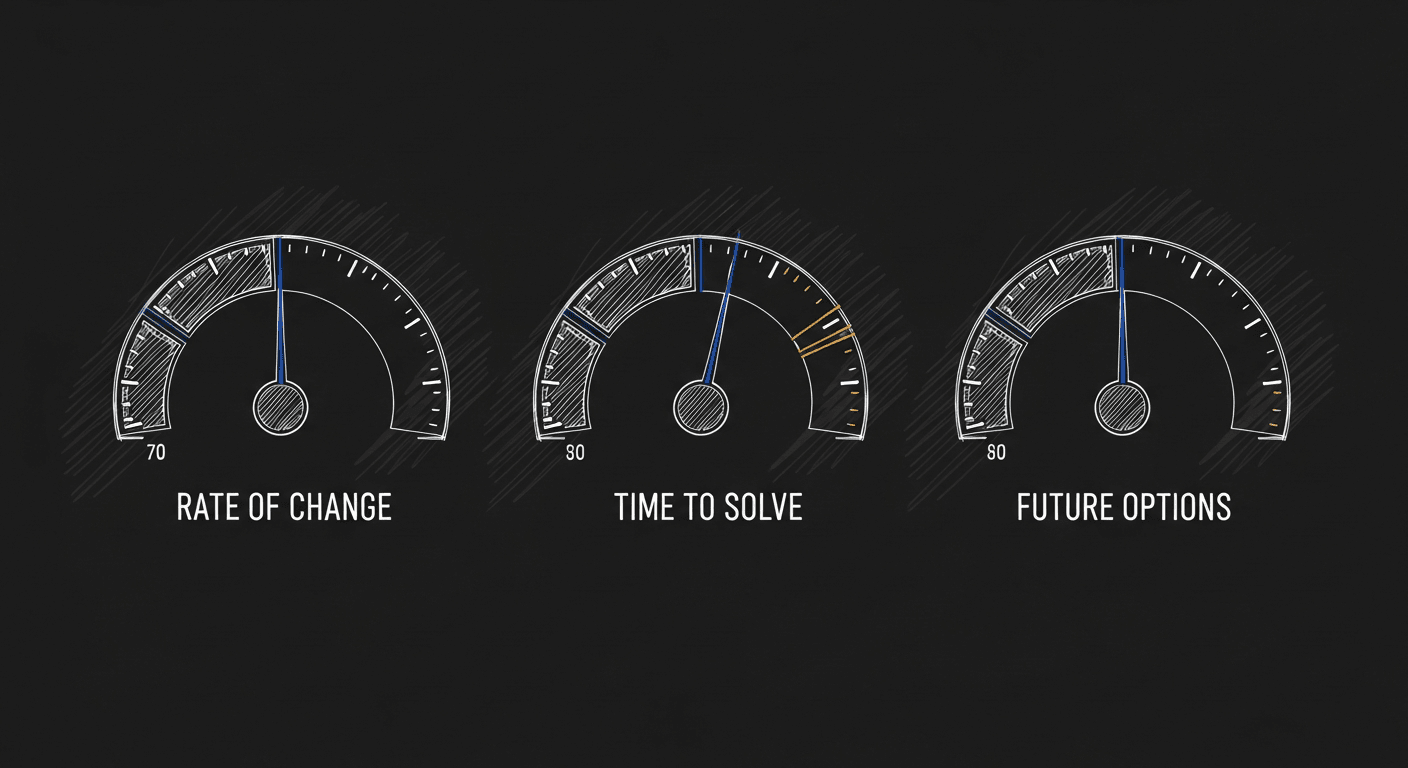
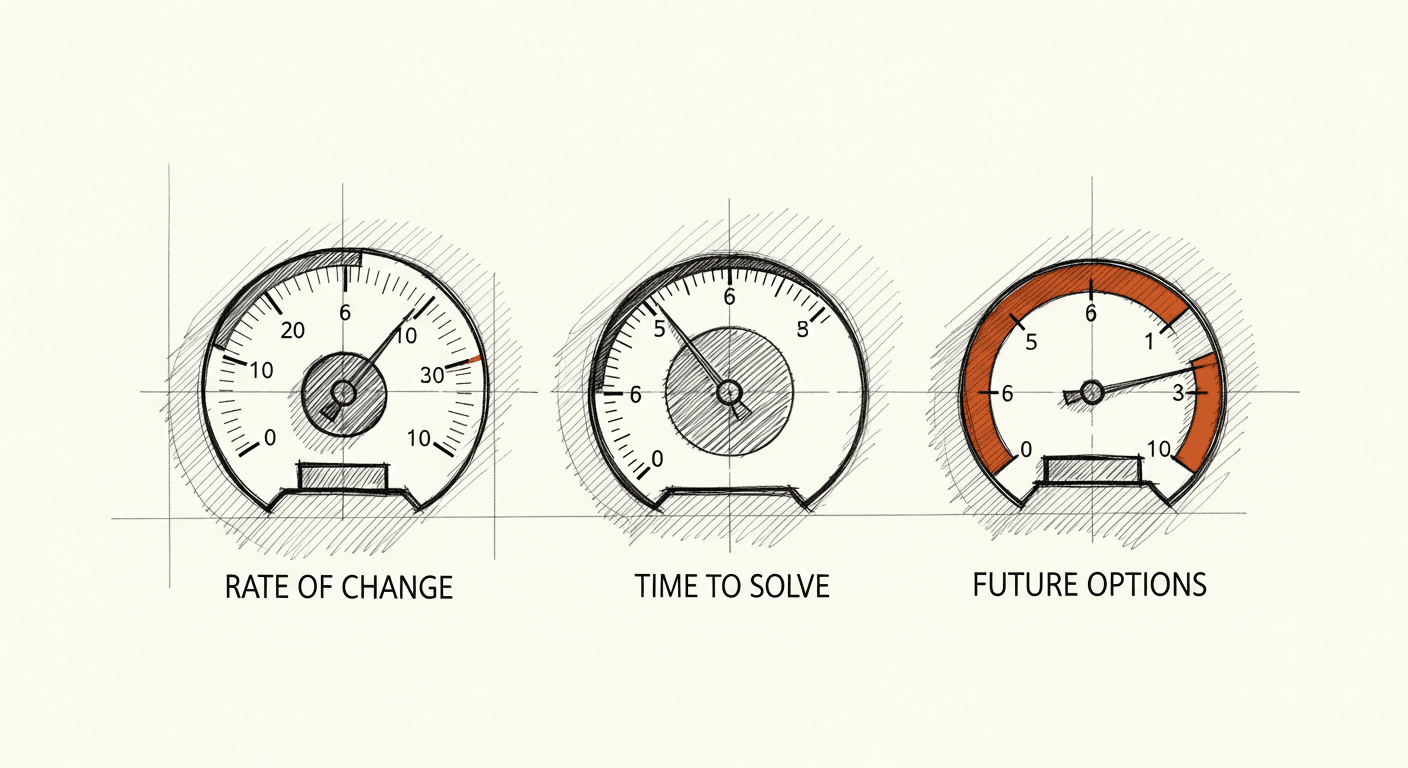
I came across this framing for measuring personal growth and it stuck because it named something I'd been trying to describe for years. Three questions, and the honest answers to them will tell you more about where you are than any performance review ever will.
I help teams ship AI in production — audits, consulting, custom agents, and eval systems. Start with an AI Audit (from $5k) for an honest read on what to build.
1. Rate of Change: What New Capabilities Have You Built Recently?
Not skills you've deepened. New ones. Things you genuinely couldn't do six months ago.
This is a harder question than it sounds. It's easy to conflate "getting faster at things I already know" with actual growth. The rate of change metric asks something more specific: is the list of things you're capable of expanding? Are you acquiring genuinely new tools, frameworks, mental models, or domains — or are you just getting more efficient within the same ones?
When I look back at the periods in my career where I was clearly growing, my rate of change was high. I was learning ML in a systems engineering context and didn't know enough to be embarrassed about it. I was building my first production AI pipeline and making ugly mistakes. I was learning how product decisions get made from the inside, not just from the engineering side. The new-ness was uncomfortable, and that discomfort was the signal.
When I look back at the period I described at the start — the one where everything was fine but somehow wasn't — my rate of change was close to zero. I was excellent at things I'd been doing for two years. That's not nothing. But it's not growth.
The question to ask yourself is blunt: What can I do now that I couldn't do six months ago? If the answer is thin, that's information.
2. Time to Solve: Are You Getting Faster at Things You've Done Before?
This one is subtler, but equally important. When you encounter problems in your domain — the kinds of problems that fall squarely within your expertise — are you solving them faster than you used to?
Genuine depth shows up as speed. If you've truly internalized something, you pattern-match faster. You skip the false starts. You know which parts of a problem are actually hard and which are just noisy. Time-to-solve compressing over time signals that your understanding is compounding, not just accumulating.
The failure mode is the opposite: when problems that should be getting faster to solve feel about the same as they always have. Or when you're reaching for playbooks and frameworks rather than genuine understanding, and your speed reflects the efficiency of your lookup process rather than the depth of your knowledge.
I built ML pipelines for years before I felt like I actually understood them. There was a long period where I was getting results, shipping models, passing code review — but still feeling vague uncertainty at each step. Then at some point, the uncertainty compressed. Problems I'd seen variants of before resolved in a fraction of the time. That's what compounding depth feels like. It's distinct from just doing the work longer.
When you stop getting faster, it usually signals that you've hit the ceiling of what this environment can teach you.
3. Future Options: Are the Paths Available to You Expanding or Narrowing?
This one requires looking outward, not just inward. At any given point, there are things you could credibly pursue next — roles, projects, domains, bets. The question is whether that space is getting larger or smaller.
Growing careers tend to open optionality. Each thing you learn, each credibility you build, each relationship you develop adds paths that weren't there before. Stagnating careers tend to narrow: you become more specialized in a shrinking context, or you get so associated with a single type of work that other categories stop seeing you as a candidate.
There's also a subtler version of narrowing that's easy to miss: when the paths available to you are all inside the same walls. If the only real next step you can see is "more of this, at higher seniority," that's a form of narrowing — even if the path looks comfortable from the inside.
I spent a long stretch getting very good at healthcare data infrastructure — HL7, FHIR, the plumbing of clinical systems. It's valuable, genuinely hard work. But at some point I looked up and realized the options it opened were mostly more healthcare data infrastructure. I wasn't building the kind of transferable capability that would make a PM want to hire me, or a startup want me on their founding team, or a fund want me as a technical advisor. My domain depth was real, but it was narrowing my aperture.
The way out was deliberate: I started taking bets adjacent to my core, building in public, taking on work where the outcome was visible to people outside my immediate context. Future options don't expand passively. You have to work the perimeter.
What I Measured When I Turned These on Myself
Applying these three metrics to my own situation was uncomfortable in a useful way.
Rate of change: I had to admit that for a meaningful stretch, I was mostly optimizing for execution speed within a domain I'd already mastered. The new-capability acquisition had slowed to nearly nothing. The discomfort of learning had become unfamiliar.
Time to solve: Mixed. In the areas I cared about and invested in, I was clearly compounding. In others — particularly anything touching the commercial or product side — I was as slow as I'd always been, which meant I hadn't actually developed there. I'd just been avoiding it.
Future options: This was the most honest reckoning. I'd been accumulating depth in a narrow stack, and while I'd always assumed that depth would translate to optionality, I hadn't tested that assumption. When I started mapping what I could credibly go do next, the list was shorter than I expected.
None of this meant things were broken. But it meant I needed to make some deliberate choices about where to invest — and stop assuming that a busy calendar and good performance reviews were the same thing as growth.
The Real Point
There's a particular kind of career stagnation that's invisible from the outside. You're well-regarded. You're compensated reasonably. Your peers see you as competent and steady. Nothing's wrong. And yet something has quietly stopped.
The conventional metrics won't show it. They're designed for comparison, not for self-assessment. They tell you where you rank. They don't tell you whether you're becoming.
Rate of change, time to solve, future options — these three will tell you. Not comfortably. Not in the way performance reviews do, with rubrics and levels and structured feedback. They'll tell you the way a mirror tells you: plainly, whether or not you're ready to look.
I wasn't always ready. But once I started asking the questions honestly, I couldn't unknow the answers.
That felt like the beginning of actually growing again.