Mostly about building products, healthcare tech, and lessons learned along the way.
Loading articles
When to Look Beyond Standard LLMs (And When to Stop Overthinking It) | Clint Johnson
When to Look Beyond Standard LLMs (And When to Stop Overthinking It)
When the standard transformer is not the right tool
About eight months into building a clinical documentation product, we hit a latency wall.
The problem was structured: a physician would finish dictating, our pipeline would kick off, and we were consistently sitting at 4–6 seconds for a full encounter summary. On paper, that's fine. In practice, the physician had already started typing, the EMR had already timed out the note window, and the AI output appeared at exactly the wrong moment. The number wasn't a research problem. It was a product problem. The root cause was that we were calling a large standard transformer through an API, waiting on a system that had been designed for quality, not latency.
That was the first time I seriously looked beyond standard LLMs. Not because the standard model was wrong for the task, but because the deployment constraints didn't match what the architecture was built for.
What I want to give you is the decision framework underneath: when does any of this matter for a practitioner? The honest answer for most people most of the time: it doesn't. I'd rather start there.
The Default Answer Is Usually Correct
If you are building a product, an internal tool, a prototype, or an agent pipeline today, the right starting point is a frontier API. GPT-4o, Claude Sonnet, Gemini Pro. Pick the one that fits your use case, call the API, and get something working.
This is not a concession. It's strategy. Frontier models are better than most purpose-built alternatives at general reasoning, instruction following, and novel task adaptation. They require no infrastructure investment, no MLOps overhead, and no specialized deployment knowledge. The total engineering cost of a production-grade custom transformer deployment, just to stand it up, not to train or maintain it, would fund months of API calls at meaningful scale.
The mistake I see repeatedly is teams that read a research blog post about an interesting architecture and immediately start asking whether they should build it, train it, or fine-tune it. The right question is: what problem are you actually trying to solve, and does the standard approach have a structural limitation for that specific problem?
If the answer is no, stop reading and go build something.
If the answer is yes, you have a real constraint that frontier APIs can't satisfy, then the architecture conversation becomes relevant.
The Four Constraints That Change the Calculus
In twelve years of ML work across healthcare, enterprise ops, and golf AI, I've found four specific situations where alternative architectures move from "interesting" to "worth evaluating seriously."
I help teams ship AI in production — audits, consulting, custom agents, and eval systems. Start with an AI Audit (from $5k) for an honest read on what to build.
Extreme latency constraints. Some applications have hard real-time requirements that standard autoregressive transformers can't meet without massive hardware investment. Voice interfaces, surgical-assist tools, any co-pilot that needs to respond within a single human breath. Standard transformers generate tokens sequentially. The cost per token is fixed, and it compounds with output length. When you need sub-500ms to first token with meaningful output length, you are fighting the architecture.
Long-context cost at scale. The attention mechanism in a standard transformer is quadratic in context length. Doubling your context window quadruples the compute. For a consumer app, this is a pricing issue. For an enterprise system processing millions of documents, medical records, legal contracts, financial filings, it becomes a unit economics problem that makes the product structurally unviable at the price points customers will pay.
Privacy and data sovereignty requirements. Healthcare, defense, certain financial applications, any system where data cannot leave a controlled environment. You can't call the GPT-4o API if your inputs are protected health information and you haven't signed a BAA. Even when you have, many clinical organizations won't allow production PHI to touch a third-party API. Self-hosted is required. Self-hosted changes which architectures are deployable.
Deep domain specialization at small scale. There are narrow domains where a smaller, purpose-built model trained on the right corpus genuinely outperforms a frontier model that knows everything but your specific thing only moderately well. Clinical coding. Legal citation mapping. Genomics annotation. At these edges, specialization compounds with efficiency: you get a model that's better on your task and cheaper to run.
If your constraint doesn't map to one of these four, the alternative architecture conversation is probably a distraction.
What's Actually Worth Knowing About the Alternatives
Assuming you have a real constraint, here's how I think about the landscape, practically.
Linear Attention Hybrids
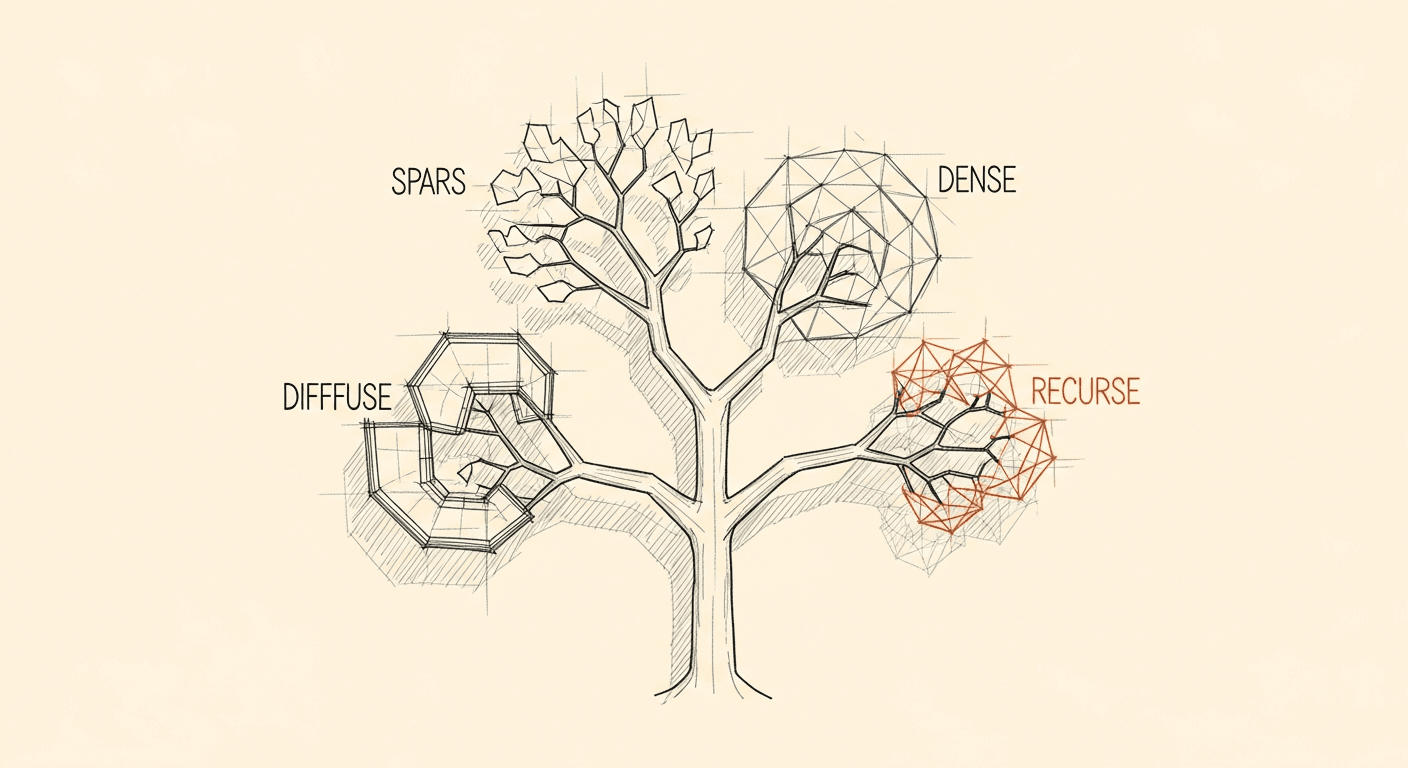
Standard attention is the bottleneck for both latency and long-context cost. Linear attention replaces the quadratic attention mechanism with an approximation that scales linearly with sequence length, trading some representational fidelity for massive efficiency gains.
The honest current state: pure linear attention models are noticeably worse than standard transformers on tasks that require attending across long distances with precision. Hybrid architectures, which interleave linear attention layers with periodic full-attention layers, are more interesting. Models like Mamba-based hybrids and GLA-style architectures get most of the efficiency gains while recovering most of the quality.
When I'd use one: long-context document processing at scale, where the precision of every attention head isn't load-bearing and the per-document inference cost is a real business constraint. Clinical chart review over full-encounter histories is a plausible case. Real-time voice summarization is another.
When I wouldn't: anything that requires careful multi-hop reasoning across a long context. Linear attention loses the fine-grained associative capacity that makes standard transformers good at those tasks.
Mixture of Experts
Mixture of Experts (MoE) is less about architecture novelty and more about scaling efficiency. Instead of activating all model parameters for every token, MoE routes each token to a small subset of "expert" sub-networks. You get a model with a large parameter count and the corresponding reasoning capacity, while only paying the compute cost of a much smaller model on any given forward pass.
GPT-4 is widely believed to be MoE. Mixtral is open-source MoE. The architecture is no longer experimental.
When I'd consider it: self-hosted deployments where I need frontier-quality reasoning but have hard GPU budget constraints. MoE gives you a path to capability that would otherwise require hardware you can't afford. It's also where you start if you're building domain-specialized models at scale — you can specialize individual experts to specific sub-domains without retraining the whole model.
The practical caveat: MoE is harder to serve efficiently than dense models. Expert routing creates communication overhead in distributed setups. You need to understand this before you commit to it in a latency-sensitive pipeline.
Text Diffusion Models
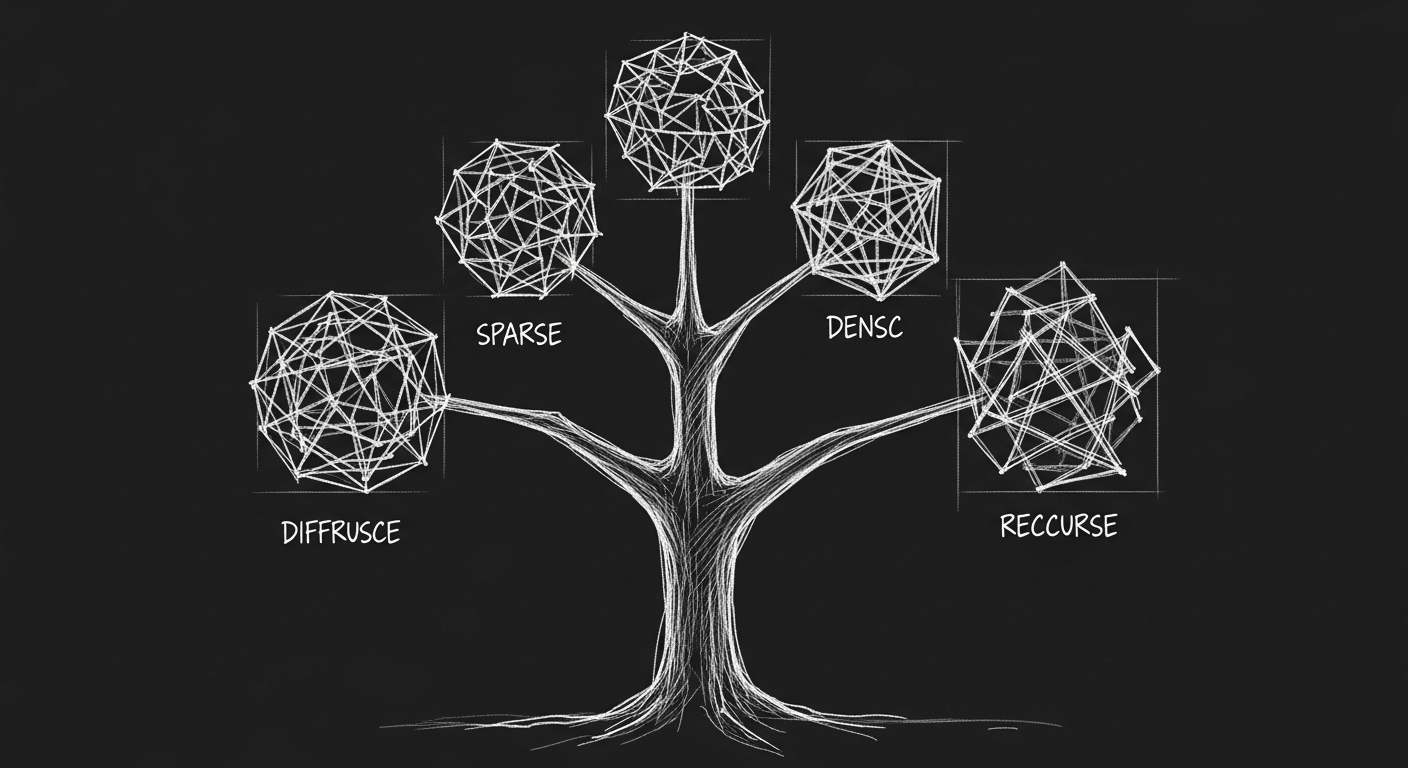
This one is more speculative, but worth tracking. Standard LLMs generate text autoregressively, one token at a time, left to right, each token conditioned on all previous tokens. Diffusion models for text work differently: they start with a noisy, underspecified output and iteratively refine it toward a target.
The potential advantage is qualitatively different generation. Diffusion models can globally revise rather than locally extend, which could make them better at constrained generation tasks where the full output structure matters (structured documents, code, formal outputs). Early results on models like MDLM and Plaid show this is a real direction, not just a paper idea.
The honest current state: text diffusion is behind standard transformers on most benchmarks today. The generation quality characteristics are genuinely different, but "different" doesn't mean "better" for most tasks yet. I'd watch this space, not deploy from it.
When it might matter first: constrained formal generation, code synthesis, structured medical documentation, legal templates, where the whole-document coherence advantage could matter before the absolute benchmark quality catches up.
Recursive and Looping Transformers
The idea here is giving a model explicit compute to "think longer" on hard problems without scaling parameters. Instead of a fixed-depth forward pass, the model can loop over its own representation, apply more computation where the problem demands it, and exit early where it doesn't.
This is closely related to what's happening with chain-of-thought and extended reasoning. The architectural version bakes this into the model structure rather than the prompting strategy.
When I'd think about this: highly constrained reasoning tasks with variable difficulty, mathematical proof checking, formal verification, complex clinical decision support. The efficiency case is: why burn the same compute on "what's 2+2" as on "summarize this 200-page clinical trial with dose adjustment recommendations"?
The Decision Framework
Here's how I work through this:
Do you have a real constraint? Map it to one of the four: latency, long-context cost, privacy, deep domain specialization. If you don't have one, stop.
Have you maxed out the standard approach? Better prompting, smaller frontier models (GPT-4o mini, Haiku), structured outputs, caching, batching, context compression. These almost always buy more headroom than people expect before the architecture becomes the bottleneck.
What is your actual operational budget? Self-hosted alternative architectures require MLOps investment: deployment, monitoring, update cadence, hardware. Do you have that, or are you trading one problem for a harder one?
Is the constraint structural or temporary? Frontier APIs get faster, cheaper, and more capable every six months. A latency constraint that justifies a custom architecture deployment today may evaporate by the time the deployment is stable.
If you're still here: evaluate linear attention hybrids for latency and cost, MoE for capability under compute constraints, domain-specific fine-tuned dense models for deep specialization. Don't evaluate text diffusion or recursive transformers for production use cases yet unless you have a research function and a tolerance for early-stage bets.
The Actual Insight
The real inflection happening in AI architecture isn't about any specific alternative to the standard transformer. It's about efficiency becoming a first-class constraint alongside accuracy.
For years, the research conversation was almost entirely about capability: how do we get models to reason better, generalize further, handle longer contexts. The deployment conversation was secondary, mostly left to infrastructure teams to solve with more hardware.
That's shifting. Latency and cost are moving from infrastructure problems to product architecture problems. Engineers building real systems at scale have to think about them at design time, not as an afterthought. That's what makes the alternatives worth understanding, not because most teams will use them, but because understanding them sharpens your intuition about what the standard approach is actually trading off.
Know what the frontier model is costing you. Know what you'd need to hit before the tradeoff changes. Then you'll know when it's time to look further.
For most teams, most of the time, that time isn't now. But when it is, you'll recognize it.