Mostly about building products, healthcare tech, and lessons learned along the way.
Loading articles
Fine-Tuning LLMs Without the RLHF Headache: The DPO Approach | Clint Johnson
Fine-Tuning LLMs Without the RLHF Headache: The DPO Approach
Simpler than RLHF. More powerful than you think.
About eighteen months ago I was leading ML work on a clinical documentation product. We had a base model that could summarize a patient encounter reasonably well. The problem was "reasonably well" meant something very specific to the cardiologists using it, and something completely different to the internists. Neither group could easily articulate why a summary was bad — they'd flag it and move on.
We had signal. Thousands of flagged outputs. A clear behavioral gap between what the model produced and what clinicians wanted.
What we didn't have was time to build an RLHF pipeline.
If you've ever been there — sitting on good preference data with no practical path to use it — this article is for you. DPO changed my thinking on this entirely, and I want to make it concrete enough that you can act on it.
Why RLHF Is the Right Idea with the Wrong Overhead
Reinforcement Learning from Human Feedback is the technique that made ChatGPT behave like a useful assistant instead of a next-token prediction machine. The idea is sound: collect human preferences (response A is better than response B), train a reward model on those preferences, then fine-tune your base model using RL to maximize the reward model's scores.
The problem is the implementation cost. You need to:
Collect enough comparison data to train a separate reward model
Train and evaluate that reward model (which can itself behave erratically)
Run RL training against it, which is numerically unstable and hyperparameter-sensitive
Debug reward hacking — the model finding ways to fool the reward model rather than actually improving
For a well-resourced lab with dedicated ML infra, this is a solvable engineering problem. For most teams — a startup, an enterprise ML team without a dedicated research org, a healthcare AI product with a three-person ML function — it's a month you don't have on a problem you can't fully validate. Most teams that want aligned models give up and prompt-engineer their way around it. That works, until it doesn't.
What DPO Actually Does
Direct Preference Optimization, introduced in a 2023 paper from Stanford, sidesteps the reward model entirely.
Here's the key insight: if you assume your language model is implicitly representing a reward function (which it is — it assigns probabilities to responses, which is mathematically equivalent to a reward signal), you can derive the optimal policy directly from preference data without ever instantiating a separate reward model.
I help teams ship AI in production — audits, consulting, custom agents, and eval systems. Start with an AI Audit (from $5k) for an honest read on what to build.
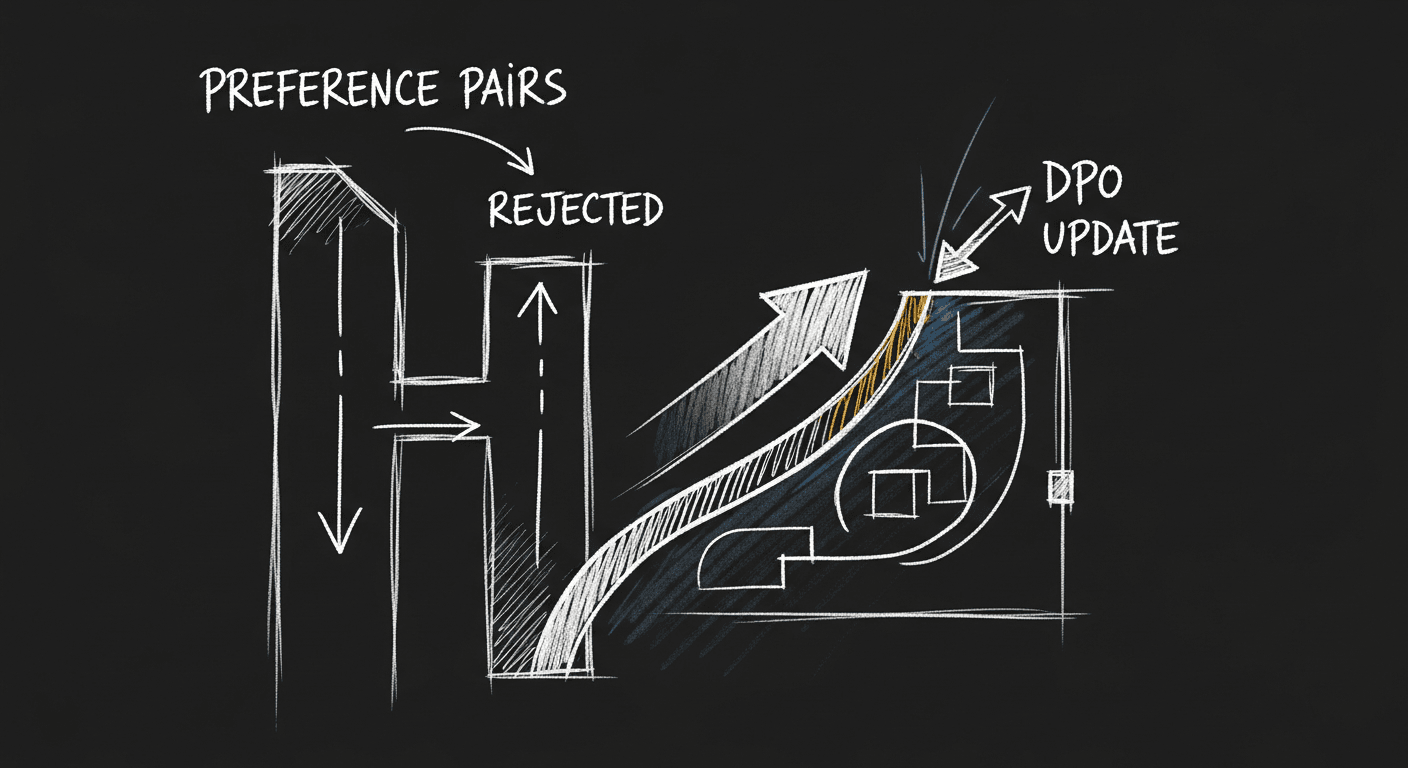
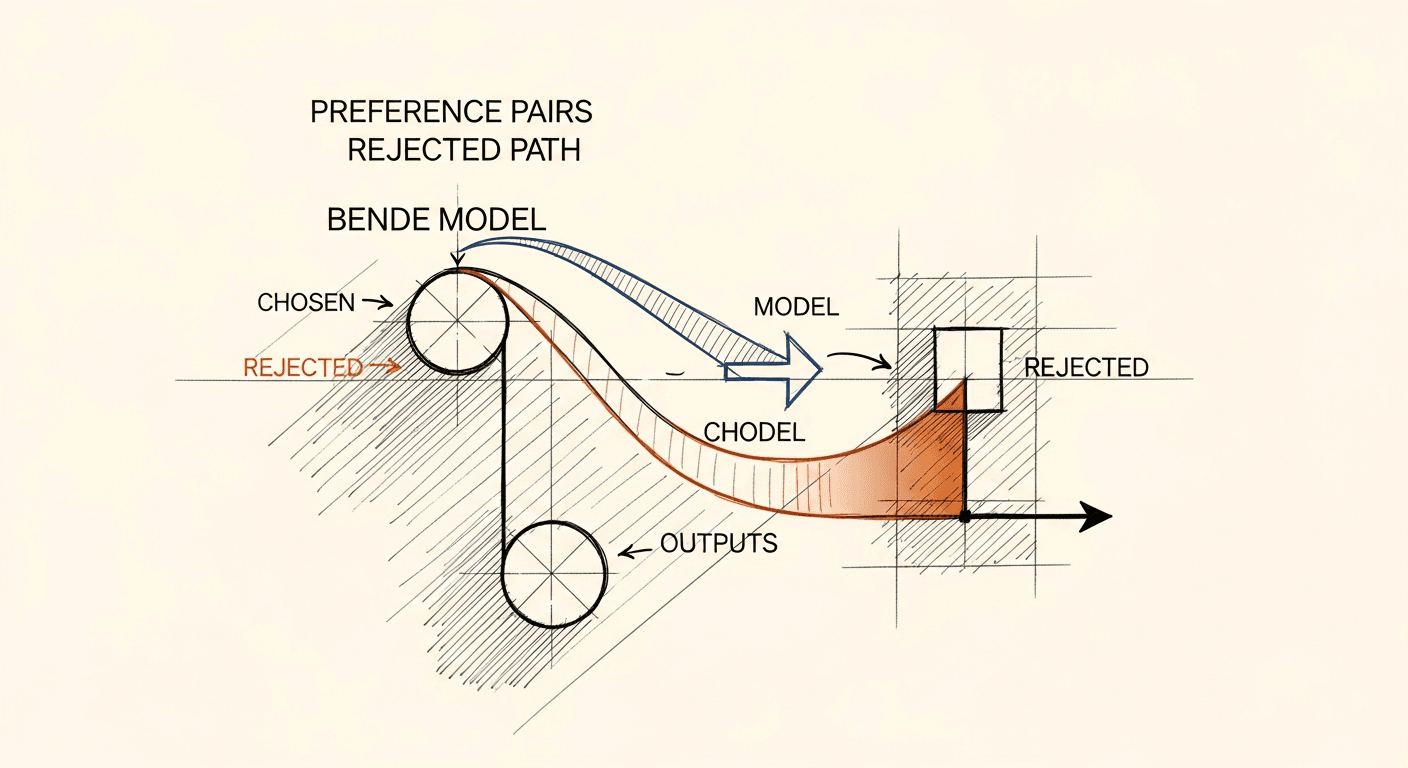
In practice, DPO turns alignment into a classification problem. You feed it pairs of responses — one preferred, one rejected — and train the model to increase the probability of the preferred response relative to the rejected one, with a regularization term that keeps the model from drifting too far from its starting weights.
No RL loop. No reward model. No reward hacking. The objective is a clean binary cross-entropy loss that any standard training stack can handle.
The practical upshot: DPO is stable to train, cheap to iterate on, and works with relatively small datasets. Current best practice for aligning open LLMs shows you can get meaningful behavioral change with hundreds — not millions — of preference pairs, especially when you use synthetic data to fill gaps.
The Four-Step Path I'd Follow Today
If I were back in that clinical documentation situation, here's exactly how I'd approach it with DPO.
1. Instrument your approval signal
You probably already have this data and don't know it. Every time a clinician accepted a generated summary without editing it, that's an implicit preference. Every time they significantly rewrote it, that's a rejection signal. If you have a thumbs-up/thumbs-down UI, even better.
The key is capturing pairs: the model's original output alongside either the accepted version or the significantly revised version. You need both sides of the comparison. Start logging this immediately if you aren't, because the data compounds fast in a production system.
Don't wait for perfect data. Messy real-world preference data, even with noisy labels, consistently outperforms synthetic-only datasets when you have volume.
2. Generate synthetic preference pairs to fill the gaps
For domains where your real data is thin — edge cases, rare diagnoses, specific documentation styles — you can generate synthetic preference pairs using a capable frontier model.
The workflow: give the frontier model a prompt, generate two or more responses at different temperature settings or with different system prompts, then use the frontier model itself (or a smaller judge model) to rank them. You now have synthetic preference pairs that encode the frontier model's behavior as a teacher signal.
This is where the 2025 open-source ecosystem genuinely helps. Models like Llama 3, Mistral, and Qwen are good enough to act as both student and synthetic preference generator. You don't need GPT-4 for every step of this.
One caveat: synthetic data teaches the model to behave like the teacher, not like your domain experts. Use it to bootstrap, not to replace real clinician signal.
3. Train with DPOTrainer from TRL
Hugging Face's TRL library has a DPOTrainer class that handles the DPO objective out of the box. The training setup looks almost identical to standard SFT fine-tuning — you provide a model, a reference model (frozen copy of the base), and your preference dataset formatted as {prompt, chosen, rejected} triples.
A few things worth knowing before you start:
The reference model matters. DPO regularizes against it. If your base model is already mediocre, DPO will improve relative to mediocre, but you won't recover from a fundamentally weak starting point. Do SFT first if your base model hasn't seen your domain data.
The beta parameter controls conservatism. Lower beta means more aggressive policy shift (higher variance, higher ceiling). Higher beta stays closer to the reference model (more stable, lower risk of degradation). Start at 0.1 and move from there.
You need less data than you think. I've seen meaningful behavioral alignment with 500 high-quality preference pairs. Quality of the comparison matters more than volume at small scales.
Evaluate on held-out preference data, not just perplexity. A model that scores better on preference win rate against your evaluation set is better, even if its perplexity goes up slightly.
4. Close the loop with production signal
The mistake I see most often: teams do one round of DPO, ship the model, and declare victory. Alignment isn't a one-time event.
Production usage generates new preference signal constantly. Build the infrastructure to capture it and retrain on a cadence that matches your product's feedback velocity. In a high-volume clinical documentation system, weekly or bi-weekly DPO updates are realistic. In lower-traffic systems, monthly is fine.
The compounding effect is real. Each iteration of real preference data tightens the model's behavior in ways that synthetic data can't fully anticipate. After three or four cycles, you'll have a model that's calibrated to your specific user population — and that's a durable competitive moat that's hard to replicate from the outside.
The Healthcare AI Dimension
Clinical documentation is a good case study because the stakes are unusually high and the preference signal is unusually rich.
Clinicians are precise editors. When they change a model output, they're making specific choices about clinical accuracy, medico-legal exposure, and communication clarity that encode a lot of domain knowledge. That signal is worth far more than a thumbs rating: it's preference data with a full semantic diff attached.
If you're building in healthcare AI, you're in a better position than most to do this well. Your users interact with AI outputs in a high-attention, high-accountability context. They notice things. They fix things. The correction rate in clinical AI is a feature, not a bug — if you're capturing it.
The counterpoint: HIPAA compliance means you need to be careful about what preference data you retain, how it's stored, and whether you're moving it to external fine-tuning infrastructure. Work this out with your compliance team before you build the pipeline. It's solvable, but it requires a conversation.
What DPO Doesn't Fix
DPO aligns behavior, it doesn't add knowledge. If your base model doesn't know how to read a cardiology note, DPO on preference pairs about cardiology notes won't teach it. You need SFT or continued pre-training for that. DPO is the final layer, not the foundation.
DPO also won't fix systemic problems with your preference data. If your clinicians are inconsistent about what they prefer (which happens more than you'd expect in multi-specialty environments), the model will reflect that inconsistency.
And DPO scales with the quality of your reference model. A bad starting point is still a bad starting point.
The Bottom Line
RLHF was never the wrong idea. It was an idea priced out of reach for most teams trying to do real alignment work on real products.
DPO makes this practical. You still need good data, a solid base model, and a feedback loop wired into your production system. But it removes the part that was genuinely hard for most teams: reward model engineering, RL instability, the debugging cycles that consumed months.
If you're sitting on preference signal from real users and haven't acted on it because RLHF felt out of reach, DPO is the path forward. The tools are there. The data you have is probably good enough to start. The compounding returns from iterative alignment are too significant to leave on the table.
Start with 500 pairs. Train for a weekend. Evaluate honestly. You'll know in a week whether it's worth building the full pipeline — and in my experience, the answer is almost always yes.