Mostly about building products, healthcare tech, and lessons learned along the way.
Loading articles
The Principal IC Playbook Nobody Shares With You | Clint Johnson
The Principal IC Playbook Nobody Shares With You
The playbook nobody hands you when you get promoted
Nobody told me that reaching principal level would feel like starting over.
I spent years getting good at the thing. ML pipelines, full-stack systems, messy data problems nobody else wanted to touch. I got promoted because I could build things other people couldn't. The week I landed the principal title, I realized I had just entered a role I had no idea how to do.
The promotion validated the old skills. The job required new ones. The gap between those two things is what this article is about.
The Paradox at the Center of This Role
Here is the thing nobody says out loud: to reach principal level, you had to become essential. You became the person who could do the thing. The expert. The one people came to when nothing else worked.
Then you arrive at principal, and the real job is to remove yourself from the critical path.
That's not a minor adjustment. It's a complete inversion of how you've been operating for the previous decade. The behaviors that got you here are exactly the behaviors that will cap you here. If you stay the person who does the thing, you're a very expensive senior IC with an inflated title. If you figure out the inversion, you become something the organization needs.
I sat with this for an embarrassingly long time before it clicked. The moment that finally landed it for me: I was debugging a model inference issue at 11pm because I was the only one who knew our ML infrastructure well enough to touch it. I fixed it. I also realized that I had been solving this same class of problem for three years, and in those three years I hadn't transferred a single byte of that knowledge to anyone else. The organization had a bus factor of one, and the bus was aimed directly at me.
That wasn't a success. That was a failure mode I had been calling job security.
What the Role Actually Is
Principal IC is not a senior engineer with more authority. It's a different function entirely.
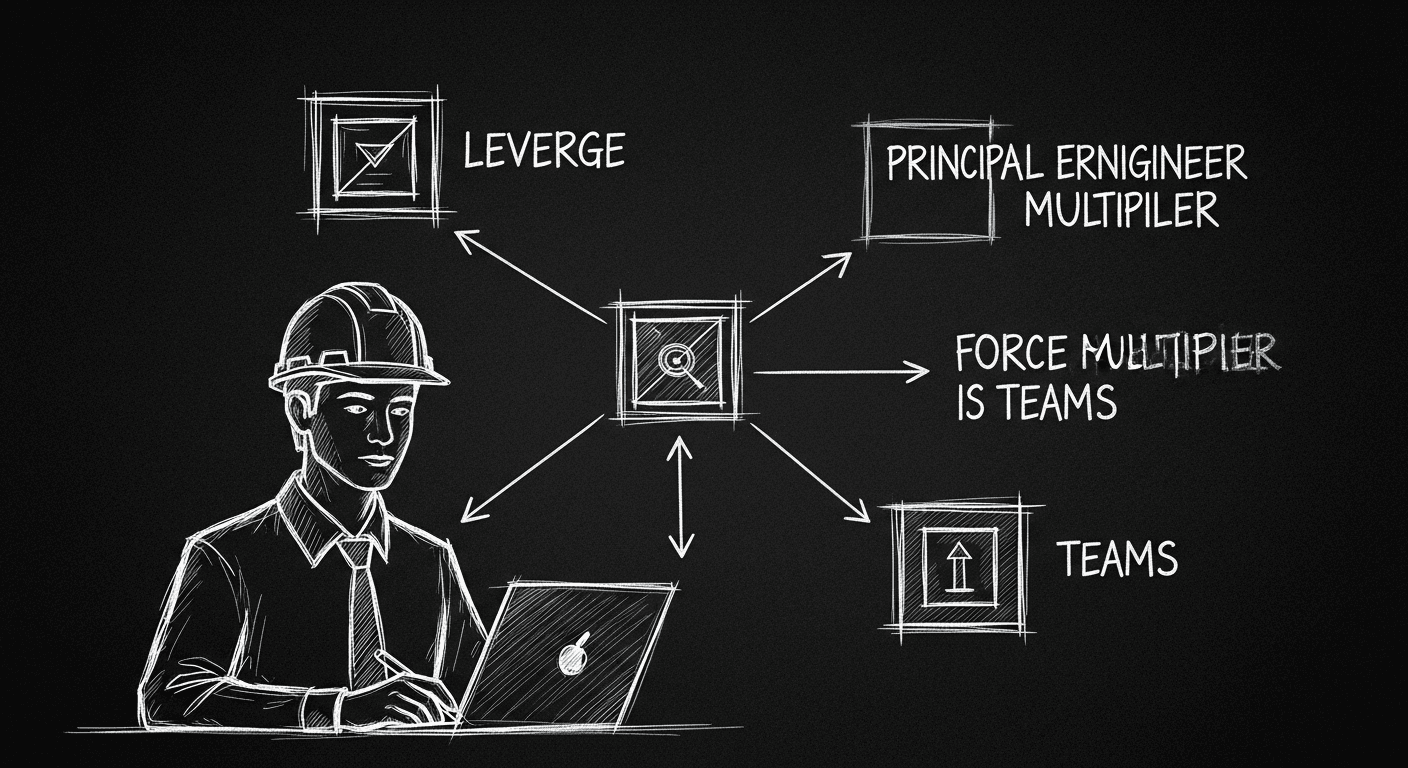
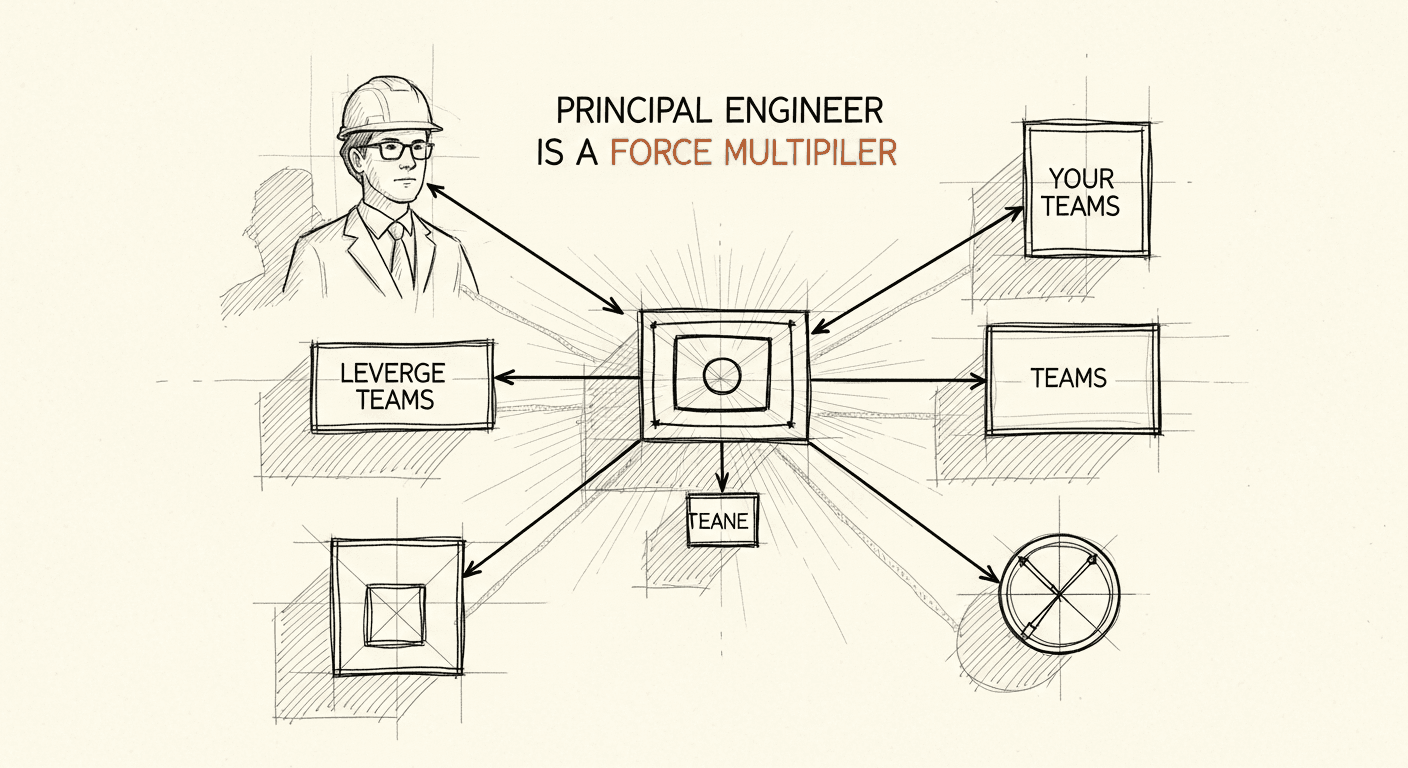
The scope of your work is no longer a project or a system. It's the technical direction of a domain, the health of a team's decision-making, and the development of the engineers around you. Your output is rarely code. Your output is the compounding capability of the people and systems you influence.
This is hard to internalize when your identity is built around building things. The question shifts from "what can I build?" to "what can I enable?" The answer to that second question is a much larger number if you're doing it right.
I help teams ship AI in production — audits, consulting, custom agents, and eval systems. Start with an AI Audit (from $5k) for an honest read on what to build.
The unique work at this level sits at the intersection of two things: what you care deeply about, and what you're genuinely exceptional at. Not just good at: exceptional. That overlap is narrower than most people think. Finding it honestly requires admitting which parts of your skill set are table stakes for someone at your level versus which parts are rare.
For me it took two years to articulate clearly: I'm exceptionally good at seeing where ML systems will fail before they fail, and I care intensely about the integrity of the feedback loop between product decisions and model behavior. Everything else I do well, but not distinctively. That narrow intersection is where I do my best work. It's also where the organization gets the most from me.
Three Mechanisms of Leverage
If doing the work is no longer the output, what is? I've landed on three mechanisms that move things at this level.
1. Teaching Organizational Values Through Technical Decisions
Every architecture review, every pull request comment, every document you write is a chance to teach the organization how to think, not just what to build. The highest-leverage version of your technical opinion isn't "here is the right answer." It's "here is how to think about this class of problem."
Be explicit about the reasoning, not just the conclusion. A code review comment that says "this will cause a race condition under high concurrency" is helpful. A code review comment that explains why distributed systems create this class of problem, what the team should be asking before reaching for shared state, and where to look in the codebase for patterns that handle it well: that comment teaches something. That comment pays forward.
The staff and senior engineers on your team are watching how you approach decisions. That's the curriculum. Teach it deliberately.
2. Connecting Dots Between Teams
This one is underrated almost universally. At principal level, you have visibility across multiple teams and systems that most ICs don't have. You're in rooms where product and engineering and platform all intersect. You see the seams.
The leverage comes from recognizing that Team A is rebuilding something Team C already solved, or that the observability problem Team B is struggling with is directly related to an architectural decision Team D made eighteen months ago. You don't need to solve these problems. You need to make the right people aware they exist and give them the context to connect.
I've probably saved more engineering weeks by making a single introduction or pointing at an existing internal tool than by writing code in the last three years. That sounds like it should feel more impactful than it does. It often feels like nothing. That's how you know it's working at the right level.
3. Scaling Through Mentorship
The highest return on your time is an engineer who can do forty hours of work with two hours of your direction. That math isn't hypothetical. I've seen it play out repeatedly, and it's why senior ICs who invest in mentorship become indispensable while senior ICs who don't eventually become isolated.
Real mentorship at this level isn't code review and rubber ducking. It's helping someone understand the shape of a problem class, not just the solution to a specific instance. It's asking the question that reframes how they're thinking, rather than handing them the answer. It's being honest when someone is technically strong but approaching their career in a way that will limit them.
The payoff is delayed. An engineer you spend serious time developing becomes a multiplier on your leverage twelve to eighteen months later. Most people can't sustain that investment because the feedback loop is too long. The ones who can are the ones who build genuinely strong teams.
The Charter Model: What 50% Time Actually Looks Like
One of the most useful frameworks I've encountered for structuring principal IC work divides your time into three buckets: owner projects, sponsor projects, and consultant work.
The rough split: one or two owner projects at roughly fifty percent of your time, two or three sponsor projects at around twenty percent total, and the rest as a technical consultant to adjacent teams and initiatives.
Owner projects are the things only you should be driving. Not because no one else could eventually do them, but because they require the combination of your specific expertise, your cross-team relationships, and sustained attention that a more junior engineer can't yet bring. For me right now, that's the ML evaluation framework I've been building. It touches model behavior, product metrics, and infrastructure in ways that require all three contexts simultaneously. I own the direction, the architecture, and the outcome.
The critical discipline: fifty percent of your time on one thing sounds like a lot until you realize how much of principal IC time is consumed by the other stuff. Meetings, reviews, mentorship, ad hoc questions. The fifty percent target is aspirational on most weeks. The value of naming it is that it forces you to protect time for deep work explicitly, because nobody else will protect it for you.
Sponsor projects are the ones you care about but aren't running. You're the senior technical voice in the room, the person who unblocks architectural decisions and advocates for the project with leadership, but the day-to-day execution belongs to someone else. This is where you develop the engineers who are ready to own things at the next level. Give them real scope, stay close enough to catch problems early, and step back far enough that they're building the muscle.
Consultant work is the rest. Technical questions from teams outside your domain, the one-off reviews, the ad hoc problems that land in your direction because your expertise is relevant. The trap: this bucket expands to fill all available time if you let it. It feels high-value because it's immediately useful and frequently acknowledged. It's often not where your principal-level work actually lives.
The charter model is useful not because it's a rigid budget but because it forces the conversation about where you're spending your time versus where the organization most needs you to spend it. Have that conversation explicitly with your manager. Update it every quarter.
What to Do With This
A few concrete starting points:
Audit your last thirty days. For every significant block of time you spent, ask which bucket it fell into. Owner, sponsor, or consultant? Is that the right distribution for where you are right now?
Name your owner project. If you can't name one thing you're responsible for driving at a level only you can bring to it right now, that's a real gap. Either there isn't one and you need to find or create it, or there is one but you haven't made it explicit enough internally.
Find two engineers to develop intentionally. Not generically mentored: specifically developed, with clarity on what capabilities you're trying to help them build and why.
Write down the thing only you know. Whatever institutional knowledge lives primarily in your head: document it. Not because you're planning to leave, but because the act of transferring it forces you off the critical path and forces others onto it.
The principal IC role is genuinely difficult in ways that aren't obvious until you're inside it. The technical work isn't the hard part. The hard part is rebuilding your identity around enabling rather than executing, and doing that without losing the craft that got you here.
It's possible to do both. It just requires figuring out which work only you can do, and ruthlessly protecting the space to do it.
I'm still figuring this out. The charter, the leverage mechanisms, the ownership-autonomy paradox: I return to all of it regularly and find places where I'm getting it wrong. That feels about right for a role that nobody fully hands you a manual for.
This article is the manual I wish someone had handed me.